

 Endnote
Balancing the books that nobody has opened
The cost of doing nothing in an economy with a leadership deficit.


Fixing the economy is Redmont’s favourite promise. it also happens to be the political arena’s least kept promise.
The economy belongs to everyone and is managed by no one. The legislature will not hold the executive accountable. The executive will not push the legislature toward any difficult, but necessary decisions. Both have quietly agreed that the economy is someone else’s problem, and that someone else has never shown up.
Hard decisions don’t win elections in Redmont — but easy, popular decisions do.
Let’s discuss budgets, banks, and money circulation.
The Budget
The most basic form of financial accountability a government owes its people is the budget. Redmont has passed and implemented one on time fewer than ten times in its entire history.
But wait. It gets better.
Never, in the history of Redmont, have two successive budgets been passed on-time. How is that for an indictment on the government’s economic management?
We have collectively accepted that budgets will be proposed late and implemented well into the financial month. A simple fix would be to propose the budget earlier by amending the appropriations act, yet, there was little political willingness to see the last proposal through.
Further to the government’s woes is that the executive has a historical issue with grasping the concept of budgeting. Since the government began routing department revenue directly into departmental spending accounts, a handful of profitable departments (notably the Department of Health and the Department of Construction and Transport), have developed a tendency to treat their revenue as their own. A department's profits are not department funds — they are Commonwealth funds.
So, we’re in a situation where:
- We can’t reliably pass a budget on time.
- We can’t adhere to constitutional spending authorisation requirements.
- There is a reluctance to fix the budgeting cycle.
What hope do we have that any progress can be made in other areas?
The Banks
Redmont’s favourite tax haven — banks.
There are two stand out options for taxation associated with banks:
- Tax bank deposits
- Tax bank profits.
We tried the latter. Banks hardly paid, posted successive ‘losses,’ and nothing was enforced until it was removed.
The argument offered in defence of taxing depositors is that taxing deposits would undermine financial institutions that cannot survive being treated like every other participant in the economy. A business model that collapses the moment it faces normal tax obligations is not a functioning market participant — it’s a liability.
But, we’ll just raise taxes on the little guy in game who isn’t in on the banking system yet to offset everyone else who doesn’t want to pay tax.
This is Redmont’s banking policy.
Circular Flow
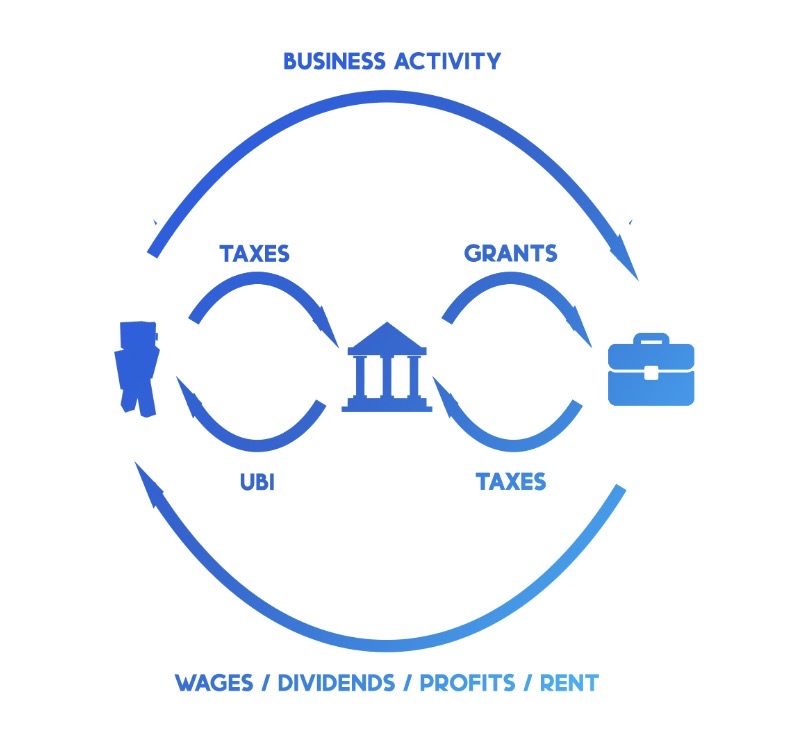
Circular flow deals with how money moves through an economy in a continuous loop between individuals, the government, and businesses.
Money used to enter the economy when people showed up to use it (joining the server). When they didn’t continue playing, it was cleaned up. The system printed to scale and burned what didn’t move. It worked, because the economy only grew according to participation in the economy.
Then we changed it.
Starting balances now flow from the government’s own account. Which sounds more respectable — but, it’s not the right option. What it actually means is that every new player draws down the government balance rather than triggering growth. When it runs dry, we print more money for the government and begin again.
There is no self-correction mechanism.
We used to print money tied to participation and burn what went unused. Now we burn through the government balance and print to cover it. The old model introduced money into the economy when people showed up to use it. The new one introduces money when the government runs out of it, which is a very different thing entirely.
We went from printing to burn, to burning and then printing.
Fixes
We need to make some big changes.
- Tax bank deposits and pave the way to lower all taxes.
- Tax bank profits and enforce it.
- Consolidate government earnings into the central government account, operate department accounts as spending accounts only.
- Start the budgeting cycle in the second week of the preceding month.
- Return to mint starting funds on player join.
And many more options, but this is a start.
More from Endnote
View all in Endnote →
Elsewhere on Gnomestack
Browse all posts → Free
Free Lenore's Summaries
The 6/7 Revolution - What was it, exactly?
Left wondering what the hell exactly happened during the 6/7 Revolution?
by Lenore Eksplosive ·
 720
720 9
9 2
2 Free
Free Juniper Blog
In Response To "Addressing the State of the Server"
This is not just about Julia's deadname. End's staff abuse goes far beyond one incident. Don't let them control the narrative.
by juniperfig

0 comments
Sign in to join the conversation.
No comments yet.